What Is an LLM? A Plain-English Guide to the Brains Behind ChatGPT
If you’ve used ChatGPT, Gemini or Claude, you’ve already talked to an LLM. You type a question, and a few seconds later a fluent, confident answer appears — sometimes brilliant, occasionally wrong. So what’s actually going on behind that little text box?
This is the first article in AI Explained, a five-part series where I break down the AI buzzwords without the jargon. No maths, no code — just how it works and what it means for you.
The short answer
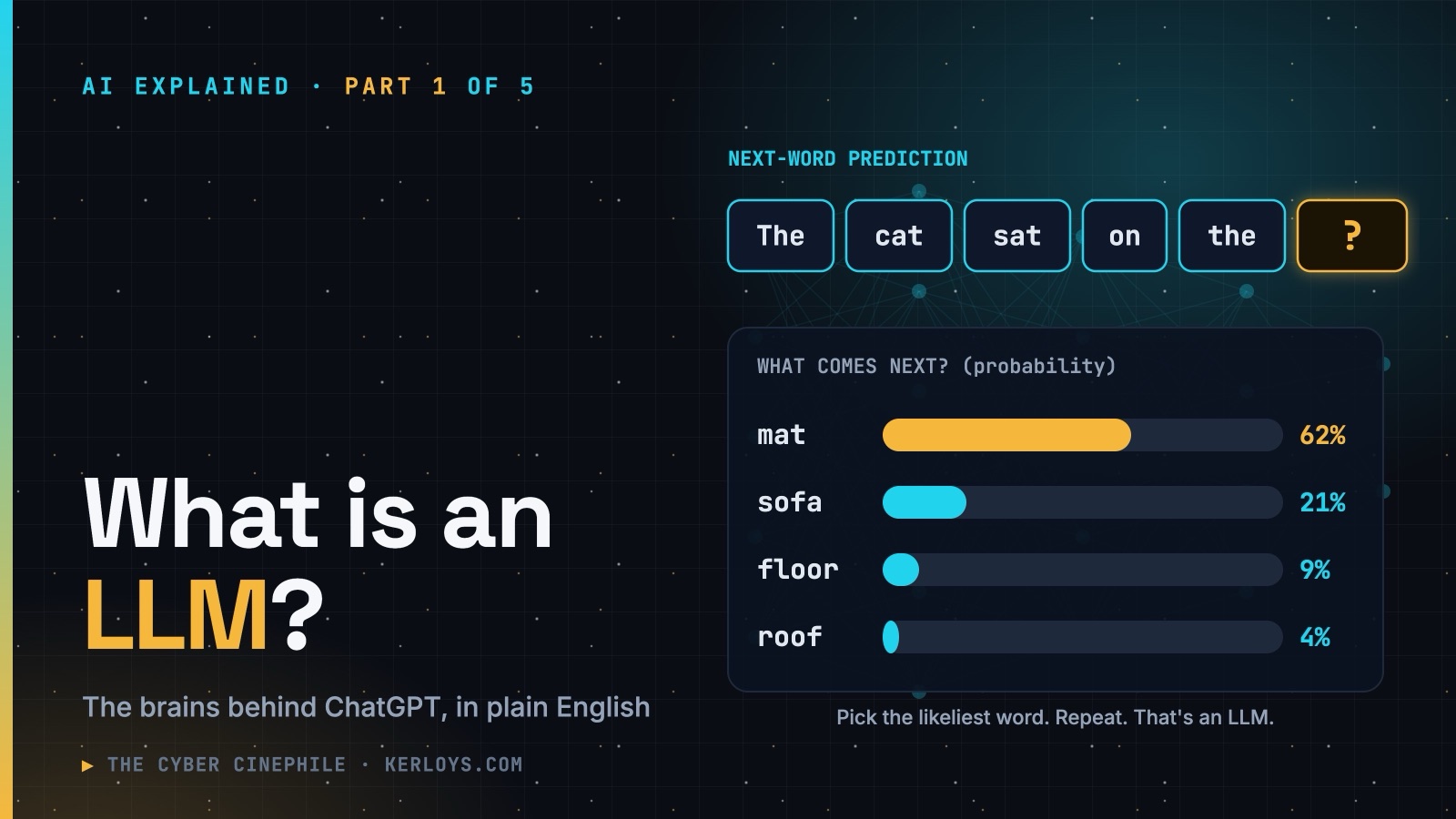
An LLM — a Large Language Model — is a computer program that has read an enormous amount of text and learned to predict which words are most likely to come next.
That’s it. Everything else you’ve seen it do — answering questions, writing emails, summarising reports, even writing code — grows out of that one skill, done extraordinarily well.
Breaking down the name
- Large — it learns from a vast amount of text: books, articles, websites, code. Far more than any person could read in many lifetimes. The model itself is huge too, with billions of internal “dials” (called parameters) that store what it learned.
- Language — its whole world is text. Words go in, words come out. Newer models can also look at images or listen to audio, but language is the core.
- Model — a simplified mathematical picture of something. A weather model predicts tomorrow’s weather; a language model predicts the next words in a sentence.
How does it learn? Think “autocomplete on steroids”
Your phone keyboard suggests the next word as you type. Type “See you” and it offers “tomorrow” or “soon”. It learned that from the way people usually write.
An LLM does the same thing at a vastly bigger scale. During training, it’s shown a piece of text with the next word hidden, makes a guess, checks the real answer and adjusts itself very slightly. Repeat that billions and billions of times across a huge library of text, and something remarkable happens: to get good at predicting the next word, the model has to pick up grammar, facts, writing styles, reasoning patterns — even a bit of humour.
To finish the sentence “The capital of France is…”, you need to know some geography. To finish “If the website is down, the first thing to check is…”, you need to know some IT. Predicting words well forces the model to absorb a lot of knowledge along the way.
A quick word on “tokens”. Strictly speaking, LLMs don’t read whole words but tokens — small chunks of text, often a word or part of one. “Cinephile” might be split into “cine” and “phile”. You’ll see the word token whenever people talk about AI pricing and limits; just think of it as roughly three-quarters of a word.
From word-predictor to helpful assistant
A model that has only learned to predict text is like a brilliant but unruly student: it knows a lot, but doesn’t know how to behave in a conversation. So there’s a second stage of training. People write example questions with good answers, and rate the model’s replies as helpful or unhelpful, safe or unsafe. The model is then tuned towards the kind of answers people prefer.
That’s what turns a raw text predictor into the polite, instruction-following assistant you chat with.
So… does it actually understand?
This is where even experts disagree, so it’s worth being honest about it. An LLM doesn’t think the way you do. It has no experiences, no feelings and no memory of yesterday’s chat unless it’s given one. But it has clearly learned deep patterns about how ideas fit together — which is why it can explain a concept three different ways, or spot the bug in your code.
A useful way to think about it: an LLM is like a very well-read colleague who answers instantly, never gets tired, and is sometimes confidently wrong.
What LLMs are great at
- Drafting and rewriting — emails, reports, social posts, cover letters.
- Summarising — turning a 30-page document into five bullet points.
- Explaining — “explain this like I’m twelve” works surprisingly well.
- Brainstorming — titles, gift ideas, project plans, names for your Wi-Fi.
- Translating and changing tone — formal to friendly, English to Malayalam and back.
- Coding help — writing, explaining and fixing code.
Where they fall short
- They make things up. When the model doesn’t know, it may still produce a fluent, confident answer — including invented facts, quotes or references. This is called a hallucination. Remember: it’s predicting what a good answer looks like, not looking it up in a database.
- They have a knowledge cut-off. A model only knows what was in its training data, which stops at a certain date. Unless it’s connected to web search or your own documents, it won’t know about last week’s news.
- Numbers and exact details can slip. Arithmetic, dates and precise figures are getting better, but double-check anything that matters.
- No real-world judgement. It doesn’t know your company, your situation or what’s at stake — unless you tell it.
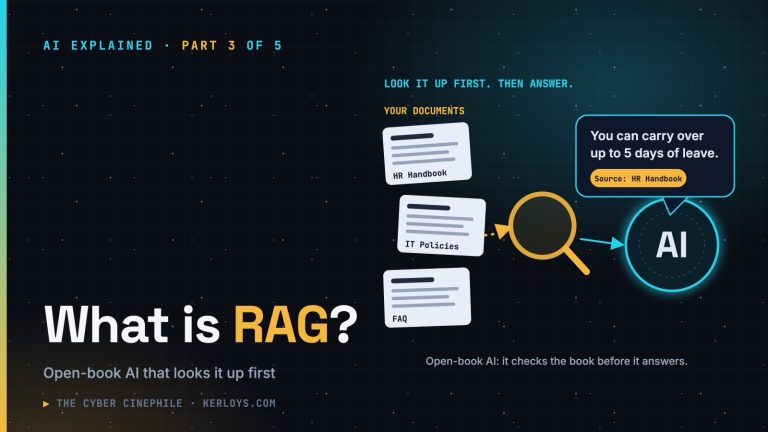
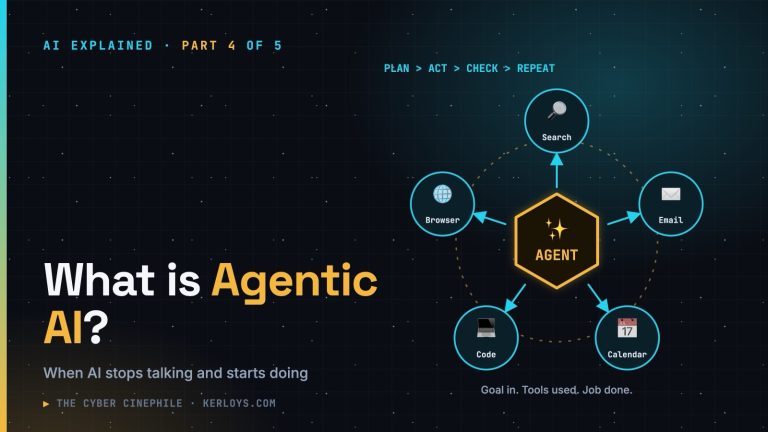
Many of these weaknesses are exactly what the rest of this series is about. RAG gives the model an “open book” of trusted documents so it makes fewer things up. Agentic AI lets it use tools — search, calculators, your calendar — instead of relying on memory alone.
A security person’s advice before you dive in
I work in cybersecurity, so I can’t write about AI without a few words of caution:
- Don’t paste secrets. Passwords, customer data, confidential documents and internal code don’t belong in a public AI tool unless your organisation has approved it. Check whether the tool uses your conversations for training — and how to switch that off.
- Verify before you trust. Treat AI answers like advice from a knowledgeable stranger: useful, but check anything important, especially legal, medical, financial or security advice.
- Watch out for AI-powered scams. The same technology writes very convincing phishing emails and fake messages. Bad grammar is no longer a reliable warning sign.
- You’re still responsible. If you send it, publish it or run it, it’s yours — AI-written or not.
The names you’ll hear
Some of the best-known LLM families and the companies behind them:
- GPT — OpenAI (the models behind ChatGPT)
- Claude — Anthropic
- Gemini — Google
- Llama — Meta (openly available for others to build on)
- Mistral — Mistral AI, from France
They differ in strengths, price and privacy terms, but they all run on the same basic idea described above.
Key takeaways
- An LLM is a program trained on huge amounts of text to predict the next word — and that one skill turns out to be incredibly powerful.
- Extra training with human feedback turns it into a helpful assistant.
- It’s brilliant at drafting, summarising and explaining — but it can be confidently wrong.
- Keep sensitive data out, and verify anything that matters.
Next in the series
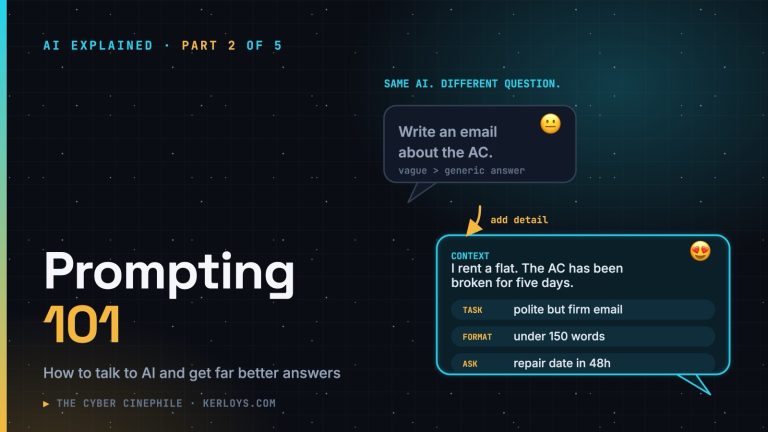
Part 2: Prompting 101 — how to talk to AI to get far better answers. After that: What is RAG?, What is Agentic AI?, and Using AI safely at work and at home.