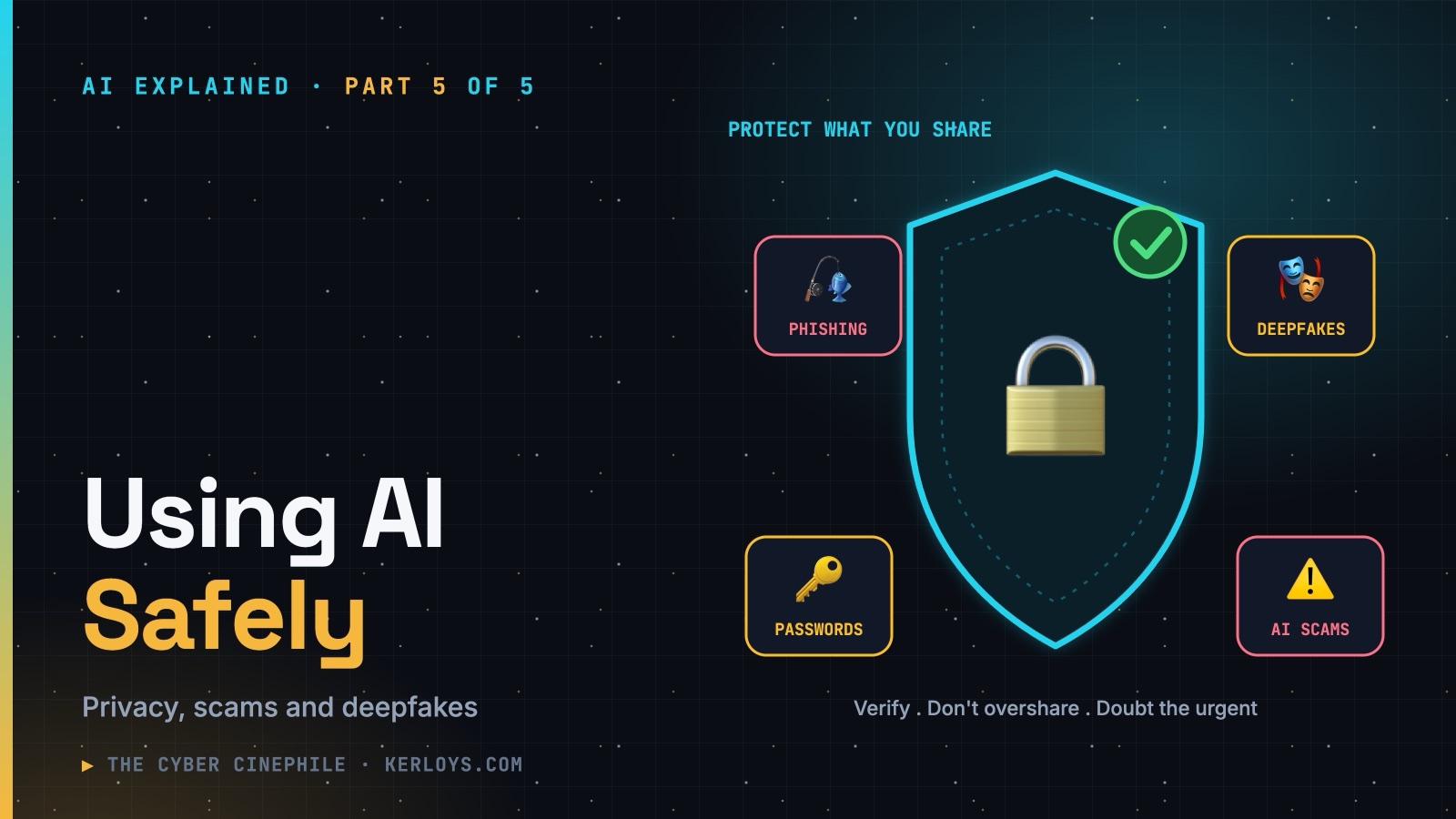
Using AI Safely: A Practical Guide to Privacy, Scams and Deepfakes
AI is no longer something you go and visit. It’s in your email, your phone, your office software and your search results. And whether or not you use it, criminals are already using it on you.
This is the final part of AI Explained. Over the series we’ve covered what an LLM is, how to prompt it, RAG and AI agents. Now for the part I care about most as a security professional: how to enjoy all of it without getting burned.
The short answer: three habits
- Protect what you share — be careful what you type into AI tools.
- Verify what you get — AI answers are drafts, not facts.
- Doubt what reaches you — emails, voices and videos can now be convincingly faked.
1. What happens to what you type?
When you chat with an AI tool, your words travel to the provider’s servers. Depending on the service and your settings, conversations may be stored, reviewed for safety, or used to improve future models. Free consumer apps and paid business plans often have very different privacy terms.
Ten minutes well spent: open the settings of the AI tools you use and check chat history, whether your data is used for training, and whether there’s a temporary or private chat mode.
Never share with a public AI tool:
- Passwords, PINs and one-time codes
- ID numbers — Emirates ID, passport, national ID
- Bank and card details
- Medical information about you or others
- Client, customer or colleague personal data
- Confidential company documents, financials or source code (which often hides passwords and keys)
The postcard test: if you wouldn’t be comfortable writing it on a postcard, don’t paste it into a chatbot.
2. Using AI at work
- Use the tools your organisation approves. Business versions usually come with contracts that keep your data out of training and under the company’s control. Unapproved tools — “shadow AI” — are one of the biggest data-leak risks companies face today.
- Anonymise before you ask. “Customer A” and “Project X” work just as well as real names.
- Beware free “summarise this PDF” websites and AI browser extensions. You often have no idea who runs them or where your documents end up. Extensions can also see everything in your browser.
- AI note-takers in meetings record everything said. Tell participants, and don’t use them for sensitive discussions without agreement.
- You own the output. If you send, publish or deploy it, you’re accountable for it — check it first.
3. The new generation of scams
AI has given fraudsters a serious upgrade. Three to know about:
- Flawless phishing. Scam emails used to give themselves away with poor spelling. Not any more. AI writes fluent, personalised messages — mentioning your employer, your role, even a recent post you made.
- Voice cloning. A few seconds of someone’s voice from a video or voicemail can be enough to clone it. The classic scam: a panicked call from a “family member” who has lost their phone and urgently needs money, or a “boss” asking for an urgent transfer.
- Deepfake video calls. In one widely reported case in 2024, an employee in Hong Kong transferred around US$25 million after a video call in which the “CFO” and colleagues were all AI-generated fakes.
How to protect yourself and your family:
- Slow down when it’s urgent. Pressure and secrecy are the scammer’s favourite tools.
- Call back on a number you already know — never the one in the message.
- Agree a family “safe word” that only you know, for emergency calls asking for money.
- At work, verify any payment or bank-detail change through a second channel, however senior the person asking appears to be.
4. Can you trust what you see online?
AI-generated images, video, audio and articles are now hard to tell apart from the real thing, and “AI detectors” are unreliable. Instead of trying to spot fakes by eye, check the source: who posted it, is it reported by trustworthy outlets, and does a reverse image search show where it really came from? Be most sceptical of content that makes you angry or afraid — that’s exactly the reaction fakes are designed to trigger.
5. Fake AI apps and downloads
The popularity of AI has created a flood of fake “AI” apps, extensions and “free premium” downloads that are really malware or data harvesters. Install AI tools only from the official website or official app stores, check the publisher’s name, and be wary of anything promising paid features for free.
6. Accuracy and connected AI
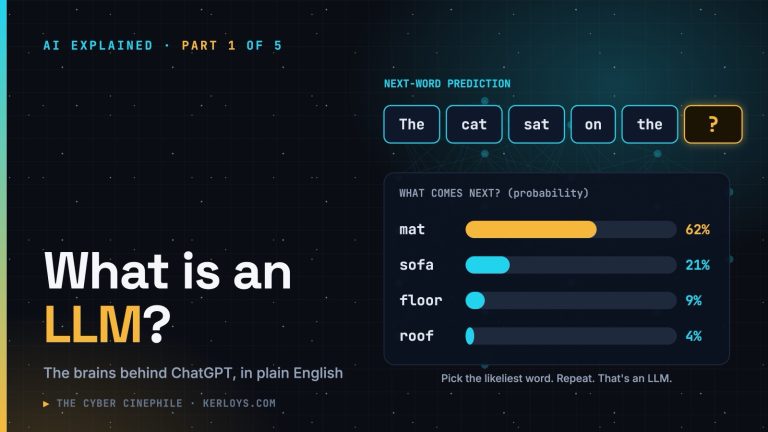
- Verify anything important — especially medical, legal, financial and security advice. AI can be confidently wrong (see part 1).
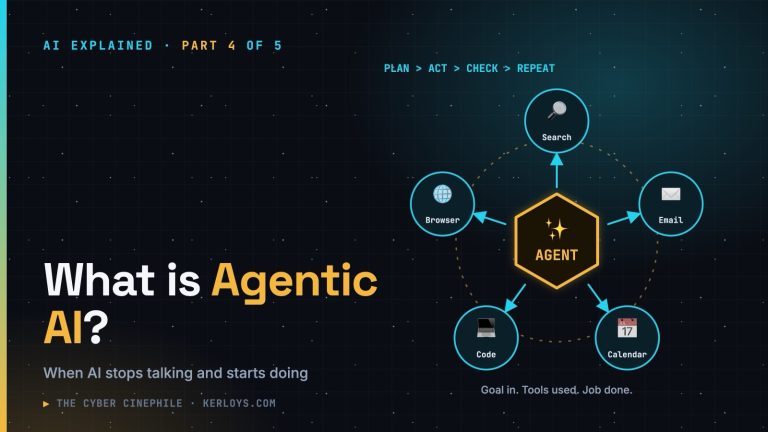
- Be careful what you connect. When AI tools can read your email, drive or calendar, or act on your behalf, give them the minimum access they need and approve important actions yourself (see part 4).
7. A word for parents
Children are using AI for homework, chat and companionship. Talk to them about it the way you would about social media: don’t share personal details, not everything it says is true, and come to you if a conversation feels wrong. Check the age limits and parental controls of the apps they use — and agree when using AI for homework is helping versus cheating.
Your AI safety checklist
- I’ve checked the privacy and training settings of the AI tools I use.
- I never paste passwords, ID numbers, financial or confidential data.
- At work, I use approved tools and anonymise sensitive details.
- I verify important answers before acting on them.
- I call back on a known number before acting on urgent requests for money or data.
- My family has a safe word for emergency calls.
- I install AI apps and extensions only from official sources.
- I give AI tools and agents the minimum access they need.
Key takeaways
- Protect what you share: apply the postcard test.
- Verify what you get: AI answers are drafts, not facts.
- Doubt what reaches you: voices, videos and perfect emails can be fake — verify through a second channel.
That’s a wrap on AI Explained
Thank you for reading the series. Here it is in full:
- Part 1: What Is an LLM?
- Part 2: Prompting 101
- Part 3: What Is RAG?
- Part 4: What Is Agentic AI?
- Part 5: Using AI Safely (you’re here)
Got a question, a topic you’d like me to cover next, or an AI scam story worth sharing? Get in touch or leave a comment below.